
Harvardwood HIGHLIGHTS - July 2026
Updated: 22 hours ago
In this issue:
MESSAGE FROM HARVARDWOOD
NEWS
Applications for the Jonathan Sethna Harvardwood LGBTQ+ Fellowship open through July 10th
Featured Job: Acquisitions & Development Producer
FEATURES
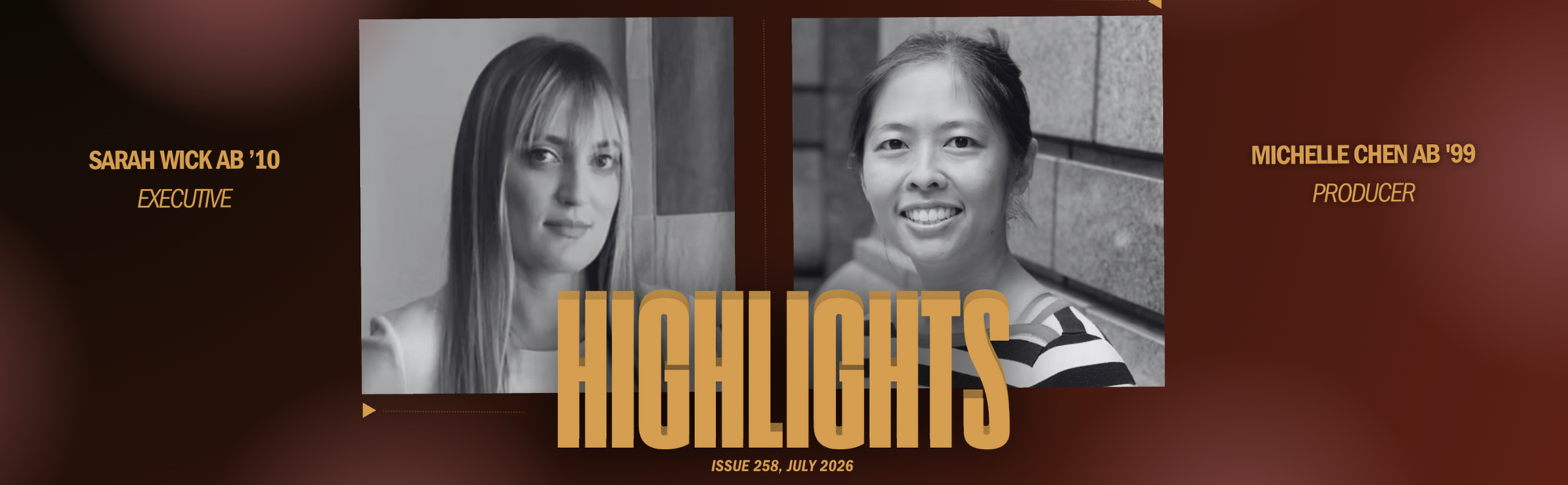
Harvardwood Profile: Sarah Wick AB ’10 (executive)
Industry News
Exclusive Q&A with Michelle Chen AB ’99 (producer)
CALENDAR & NOTES
Last Month at Harvardwood
Want to submit your success(es) to Harvardwood HIGHLIGHTS? Do so by posting here!
July, here we go:
Apply to the Jonathan Sethna Harvardwood LGBTQ+ Fellowship!
Done!
As always, if you have an idea for an event or programming, please tell us about it here. If you have an announcement about your work or someone else's, please share it here (members) and it will appear in our Weekly and/or next HIGHLIGHTS issue.
Best wishes,
Grace Shi
Operations and Communications
Apply for the Jonathan Sethna Harvardwood LGBTQ+ Fellowship
Applications close July 10th at midnight PT!
Harvardwood is excited to announce the fourth year of the Jonathan Sethna Harvardwood LGBTQ+ Fellowship for projects that elevate LGBTQ+ characters, themes, and stories by creatives and screenwriters who are Harvard University alumni.
The purpose of the Fellowship is to polish, develop, elevate, and amplify projects for the screen with LGBTQIA+ characters, themes, and stories. The gift, generously donated by Jonathan Sethna (HGSE ’03), will support one Fellow and their project with a grant of $5,000. Additional Fellows may also be awarded. In addition to grant funds, Fellows will receive one-on-one guidance and mentorship from Harvard Alumni that want to empower artists to make the world a better place through their stories.
Featured Job: Acquisitions & Development Producer
Job Description:
As a member of the NPR Visuals Team, the Producer III is an experienced visual storyteller who brings strong editorial judgment and a distinct visual sensibility to NPR's video work. This role is for a seasoned industry professional responsible for building and curating NPR Studios' film slate, working across original development and acquisitions. The Producer III will leverage deep industry relationships and a strong understanding of the documentary marketplace, including financing, audience strategy, and distribution pathways. This role plays a central part in shaping NPR Studios identity as a national platform for cinematic digital-first documentary storytelling. Finally, the role will help define the editorial vision and external partnerships that position NPR Studios within the broader documentary ecosystem. This position may occasionally require working nights, weekends and holidays as needed and could require periodic travel. This position reports to the Director of NPR Visuals.
Alumni Profile: Sarah Wick AB ’10 (executive)
by Laura Frustaci AB '21

Prior to L.A. Material, Sarah Wick spent six years as C.O.O. at Crooked Media, an audio and subscription based media company, and General Manager of a digital gaming vertical at Disney Interactive. An L.A. native, Sarah is happiest working in her garden and foisting her citrus on people.
When Sarah Wick AB ’10 graduated from Harvard during a recession, she says that, “the entertainment industry was already starting to shift… you could feel the TV and film business contracting.” On the positive side, digital media was starting to unfold as a newly viable path. “YouTube was becoming a real platform, and the idea that content could be created and monetized outside of traditional systems felt new and exciting,” Sarah recalls. “It had an early, almost ‘old Hollywood’ energy to it.”
That’s how Sarah ended up at Maker Studios, which was later acquired by Disney. At Maker Studios, she ran one of the largest verticals in the company and realized that she was pulled towards startup environments, where everything is messy and it’s a lot of throwing things at the wall to see what sticks. That propensity for problem-solving led her to join Crooked Media after the 2016 election. “I joined the company as COO and the first non-editorial employee.” There, she helped scale the company across audio, subscriptions, and community. “During that time, I became increasingly focused on local news and the role it plays in shaping how people understand the world around them.” Once she left Crooked Media, Sarah found herself returning to the same question over and over: how could she make a city like Los Angeles easier to understand?
The answer was L.A. Material: a new digital news outlet that aims to make Los Angeles legible. L.A. Material launched this March, led by Sarah and her co-founders, Julia Wick (her sister), who won a Pulitzer at the LA Times, Hayes Davenport AB '08, a close friend who Sarah met on the Harvard Lampoon and Julia Turner, who has a background running Slate and serving as a masthead editor at the LA Times. "Our hope is that we are combining editorial strength with a new, digital-first business model designed to actually sustain itself.” Sarah says. She and her team want to make the city “legible,” and addressing the gap of understanding what’s actually happening in L.A. is the organization’s goal. The team encompasses “some of the best journalists” (several of whom have Pulitzers or have overseen newsrooms that have won similar awards).
“The information exists, but it’s fragmented, buried, or shaped by incentives that don’t always serve readers,” Sarah notes. “At the same time, I had seen firsthand how local news ecosystems were collapsing. Publications are shrinking, consolidating, or disappearing altogether. When I was growing up, L.A. had a thriving media landscape. That’s no longer the case, and I believe you can profoundly feel the absence. It impacts accountability, civic understanding, and even community. I think about how much people like Jonathan Gold made the city feel full of energy and possibility and how vital that collective feeling is for a healthy, thriving city.” Sarah has a background in venture capital, which she feels sharpened how she thinks about focus, capital efficiency, and the importance of creating a strong company narrative. Combining this past experience in VC with her time at Crooked Media, which was formative in learning how to create a modern media company, positions her and L.A. Material well for a future of success. “It’s not only a newsletter,” Sarah says. “It’s a platform that will extend into reporting, audio, events, and community.”
All of those aspects mean that Sarah’s everyday life consists of a mix of programming, operational, and strategic work. She wants to ensure that everything they’re publishing hits two key goals: clear and useful. Sarah says of the future: “The goal is to become a core information source for Los Angeles, something people rely on to understand the city in a clear and consistent way. That includes expanding the newsroom, increasing coverage, and building out additional formats. We’re launching a podcast and considering other audio products, which makes sense in a city where people spend so much time commuting.”
The goal ultimately is to expand into in-person experiences as well, with events and community-building engagement. In a world where there is such an influx of polarization in the media, Sarah says that “Clarity and trust are the antidote.” Sarah wants L.A. Material to be a transparent source for news, elevating strong journalists and attaching real accountability to the work she and her team are doing.
In terms of her advice for others looking to make their start in journalism and media, Sarah has advice that she tries to live by every day and was key to the foundation of L.A. Material. “Work with people who are better than you in specific areas and trust them to lead in those areas,” she states. “That requires being clear about what you don’t know and giving people the space to do their jobs well. When you build a team like that, you get better outcomes and a stronger organization overall.”
Industry News
Marty Bowen AB ’90 is an executive producer of TOMORROW, AND TOMORROW, AND TOMORROW, a Paramount adaptation of Gabrielle Zevin’s bestselling novel of the same name. The film—directed, produced, and written by Siân Heder—is set to arrive in November 2027. (The Hollywood Reporter)
Matthew Aucoin AB ’12’s TWO THRESHOLDS (SYMPHONY) is set to have its world premiere performance at the Aspen Music Festival on July 19th. The piece is co-commissioned by the Aspen Music Festival and School (AMFS) with the launch of their First Symphonies Project, a multi-year initiative aimed at commissioning first symphonies from U.S. composers. (Chicago Symphony Orchestra)
James Bundy AB ’81 was one of three Special Awards recipients at the Connecticut Critics Circle Awards, an event aimed at celebrating artists devoted to regional theater and promoting Connecticut-produced productions. He is retiring as the Elizabeth Parker Ware Dean of the David Geffen School of Drama and Artistic Director of Yale Repertory Theatre. (Broadway World)
Jehane Noujaim AB ’96 is the director of THE MAN WILL BURN, an HBO Original four-part documentary series following the evolution of Burning Man since its origination in 1986. The series will debut on July 9th on HBO, with subsequent episodes releasing every Thursday. (Warner Bros. Discovery)
Dean Norris AB ’85 is the writer of DO WHAT YOU’RE GONNA DO: THE DEFINITIVE ORAL HISTORY OF BREAKING BAD, a book about his time on BREAKING BAD as DEA Agent Hank Schrader. The book, co-authored by Joe Layden, is set to release on November 3rd. (Collider)
Kurt Crowley AB ’07 is a composer and lyricist of AMONG THE STARS, a new original musical following seekers in a remote desert community and three skeptical outsiders. An invite-only staged reading will take place on August 23rd after a two-week developmental workshop. (Broadway World)
Lev Grossman AB ’91 is a finalist for the Mythopoeic Fantasy Award for Adult Literature in the 2026 Mythopoeic Awards for his Arthurian fantasy novel THE BRIGHT SWORD, which follows the surviving Knights of the Round Table, and the aftermath of King Arthur’s death at the Battle of Camlann. Winners will be announced during Mythcon 54, a three-day conference held from July 24th to July 27th in Weatherford, Oklahoma. (Locus)
Bess Wohl AB ’02’s play LIBERATION won the 2026 Tony Award for Best Play. The play has received numerous accolades since its Off-Broadway run, with a London production set to debut in 2027. (Playbill)
Diallo Riddle AB ’97 appeared in SCARY MOVIE 6, which released on June 5th nationwide. His character, Random Black Guy, is thought to represent his character, Stevie, from MARLON, a sitcom co-created and starring Marlon Wayans, who was a writer, producer, and actor for the film. (Instagram)
Yo-Yo Ma AB ’76 released YELELE MAMA, a song made in collaboration with Exile Key, an artist collective based in Kenya’s Kakuma Refugee Camp. The song was released in honor of World Refugee Day on June 19th. (The Strad)
Stefan Jackiw AB ’07’s tenure as the Artistic Director of the Hawai’i Chamber Music Festival has been extended to the 2031 season. The violinist, whose tenure was set to end this June, has been considered central to the growth, vision, and identity of the organization since he assumed the position in 2023. (Stefan Jackiw)
Galt Niederhoffer AB ’03 has been named Imagined Editor of Switchboard Magazine, a digital publication that publishes original nonfiction and fiction writing, focusing on “innovative adaptability, inclusive storytelling, integrative success, and impactful content.” The publication has acquired five short films that will screen at the Indy Shorts International Film Festival, which takes place on July 21st to July 26th in Indianapolis, Indiana. (Deadline)
Ben Mezrich AB ’91 is the author of CHECKMATE: GENIUS, LIES, AMBITION, AND THE BIGGEST SCANDAL IN CHESS. The book dissects the impact of the controversial chess match between Hans Niemann and Magnus Carlsen in 2022, which shook the international chess community. (Mountain Times)
Paris Barclay AB ’79 is the writer and director of BILLY PRESTON: THAT’S THE WAY GOD PLANNED IT, a documentary about keyboardist, singer, and songwriter Billy Preston. The film, which was released in February, is the first film uploaded to the Academy Screening Room, putting it up for consideration for the upcoming Academy Awards. (Variety)
Stockard Channing AB ’65 is making her directorial debut with KRAPP’S LAST TAPE at the Edinburgh Festival in August, with four preview performances in London on July 24th and July 25th. Originally written by Samuel Beckett, the play follows Krapp, a 69-year old man who reflects on his life as told by tapes he recorded over the years. (Broadway World)
Visual Artist Flora Kao AB ’00's show, W/HOLE: 100 Views of Fish Harbor, is open through July 24 at Gallery 825 in West Hollywood. It examines the historic significance of Terminal Island for Japanese-Americans of Southern California. (LAAA) Flora is also showing an expanded body of work in the Built on Water group show at Angels Gate Cultural Center in San Pedro which runs through Aug. 15. (AngelsGateArt)
Melinda Hsu AB ’92's new book LEAD WITH KINDNESS, your handbook for how to instill and sustain kindness-driven business practices in order to create successful outcomes, is available now. (Simon & Schuster)
Exclusive Q&A with Michelle Chen AB ’99 (producer)

Michelle Chen is Senior Producer, Kids’ Media and Education at The WNET Group, where she has been creating content for public media broadcast and digital platforms since 2004. She has received Emmy Awards for her work on the PBS KIDS series CYBERCHASE and the multiplatform project, GET THE MATH. Other projects include the groundbreaking educational gaming series MISSION US, which has received the Japan Prize for Educational Media and the Games for Change Award for Most Significant Impact; the Emmy-nominated PBS KIDS preschool math series COUNT ON JUNE BUG!; the Youth Collective Gen Z engagement initiative; the PBS KIDS video and gaming OH NOAH!; and professional development video series for educators. She received her bachelor’s degree in biology from Harvard University.
Q: How did your time at Harvard impact your career in media and your journey into the world of production?
My time at Harvard was critical in shaping my path to a career in production! Entering my first year, my intent was to pursue a career in ecology research. I had always loved participating in the arts but had never considered it a real career option. Some key experiences at Harvard helped open my mind to that possibility.
First, I was part of the first FAP (Freshman Arts Program) my first week at Harvard. It was there that I met three other first-years who would become my co-producers and co-founders of the first Freshman Musical at Harvard. It was our first experience as producers, and I absolutely loved it! Being able to shepherd an entire production from concept and fundraising, through scripting, casting, rehearsals, production, marketing, and the incredible feeling of seeing it all come together in the performances was the most personally fulfilling experience I had known. I caught the producing bug and started producing shows every semester.
So I learned that I enjoyed the role of producer, but it wasn’t until I got involved with the Harvard AAA (Asian American Association) that I began to view it as a career possibility. Later on in freshman year, at the AAA Intercollegiate Conference, I saw a keynote speech by Chris Lee, who at the time was the head of production at a major Hollywood studio. Knowing that an Asian American producer could attain that level of success in the industry was eye-opening and truly inspiring. It started me on a path to seriously exploring a career in production.
From there I started doing production internships, taking animation classes, attending industry events, and of course continued producing shows – most of them for the AAA Players, the Asian American theater group on campus. By the time I graduated from Harvard with a degree in biology, I was fully committed to becoming a professional producer.
Q: What particularly inspired you to get involved with Thirteen/WNET? What is your favorite part about your job? Do you have a least favorite (or most challenging) part?
As a producer I’ve always been interested in creating work that educates, inspires, and opens audiences up to new perspectives. Because these goals align perfectly with the mission of public media, I’ve been a long-time admirer of Thirteen/WNET (New York’s PBS station) and hoped to work there someday. I did an internship there during college and kept my eye on openings there when I was looking for work. A few years after graduation, I ended up applying for a production coordinator position with the Kids’ Media & Education team working on their long-running math/STEM series CYBERCHASE. Truthfully, I would have been happy to work on any of WNET’s productions, but this position ended up being a great fit for my experience – I had a background in STEM with my biology degree, had experience doing low-budget production with a small indie company I had run with friends (Fluid Motion Theater & Film), and had also worked in non-profit fundraising at the Public Theater and the Museum of Chinese in America.
There are many things I love about my job, but one of my favorite things is knowing that my work is having a positive impact on kids and families across the country. It is so rewarding to receive feedback from children, parents, and teachers sharing how much they enjoy our shows and games, and telling us what they’ve learned – or to even see it firsthand when we’re able to test our content with kids and families. It’s especially wonderful when we hear from young adults who tell us how our media impacted them growing up – like those who watched CYBERCHASE as kids and say it led them on a path to careers in science or engineering. That mission is what motivates me every day.
My least favorite part is probably the uncertainty and instability our industry has been facing. Rather than being fully focused on the media itself, much of our time and energy is often occupied trying to advocate for our projects and ensure we can continue creating this kind of work.
Q: What do you look for when you are deciding to develop a show? How much does entertainment value come into play versus educational value?

When approaching educational media for kids, I think there are three fundamental things we focus on: 1) where is the need; 2) what is relatable to kids and builds on their interests; and 3) what is effective? In terms of the need, we spend time doing research and consulting with education experts to find out what curriculum areas kids are struggling with and where they need more support, as well as where there are gaps in available resources for families and teachers. For example, we know that building early math skills is critical for kindergarten readiness and later success in school, and we know that many parents and educators are looking for resources to support their kids in building these skills. So we work with early math advisors to try to drill down on which particular skills and concepts are most challenging or receive less attention (such as patterns, measurement, and subtraction.)
In order to accomplish our educational goals, it’s equally important that we create media that engages kids. So we work on creating characters that are appealing and relatable – the type of characters kids will want to be friends with or aspire to be like themselves. We also try to develop worlds that are fun and inviting and storylines that are whimsical, funny, and again, relatable to kids in the target audience. So for example, our new preschool math series COUNT ON JUNE BUG! builds on young kids’ fascination with nature. It stars a spunky, adorable little beetle who’s funny, quirky, and has an infectious zeal that leads her and her friends into some silly situations. June is a tiny bug exploring a big, big world – much like the young kids in our target audience – but she and her friends are also doing the kinds of things kids do in their day to day lives, like playing games, going on scavenger hunts, having birthday parties, and making up silly dances. Ultimately, it’s the lovable characters and the fun stories that will keep kids coming back to learn more.
And of course, we want our media to have a real impact. Whenever possible, we try to conduct formative testing with kids and families in the target audience as we’re developing new videos or games. This helps us to assess whether the approach we’re taking is appealing to kids and whether it’s actually helping them to understand key concepts. And sometimes our kid testers give us helpful suggestions to make our games better! For example, in a CYBERCHASE game where players were tasked with hunting down sources of noise pollution, kids commented that they wanted to know why certain noises were harmful. In response, we ended up refining the game script to include feedback from characters explaining the potential harms caused by different noisy objects – like how loud noises can disturb animals. We also value the opportunity to work with researchers to conduct evaluations of our completed work to assess the effectiveness of our work in moving the needle on our educational goals, so we can build on these learnings in future projects. We’ve been thrilled to find that kids using our projects CYBERCHASE and MISSION US have shown measurable learning gains in independent studies.
Q: What are the current threats to or challenges with educational media, and how are you working to fight those?
As educational media and public media producers, I think we are facing the most challenging environment I’ve seen in 22 years. Since we operate on a non-profit, non-commercial model, funding has always been a challenge. But recent significant cuts in federal funding have made this a particularly difficult time. While we still receive support from other sources (e.g., foundations, state/local funding, corporate, individuals), we have had to adapt to a new funding landscape. We’ve had to prioritize and make some unfortunate cuts, while thinking about ways to leverage limited resources and find new revenue sources.
Another major challenge we face is the rapidly changing media landscape. The transition to a digital-first world with the emergence of YouTube, social media, and streaming platforms have all happened since I started working in the industry, and I think many producers are still scrambling to catch up. For today’s kids, who have grown up as digital natives using their parents’ phones, tablets, and streaming devices from a very young age, we need to keep pace with the latest trends to make sure we’re meeting kids where they consume media and addressing their interests and needs. Because of this, it’s critical that we do research and talk to kids, families, educators, and other experts on a regular basis. The need to generate new content on a more frequent basis than the traditional broadcast season model has also driven us to think about ways to be more nimble. This can sometimes feel at odds with our goal of maintaining a high standard for the educational value and effectiveness of our content, but we’re trying to be thoughtful about evolving our strategy. We are creating more short-form content, shifting to a primarily digital distribution strategy, and thinking about ways to creatively curate and leverage our vast library of existing content, all while keeping our learning and impact goals in mind as our “north star.”
And, of course, AI is a big potential challenge! There is clearly great potential as well as great risk in the possibilities AI holds for the industry. Like many others in public media and educational media, we are taking a cautious approach to exploring the possibility of incorporating AI in our work, but it may become a regular part of our reality before we know it.
Q: What project or piece of work has been the most fun for you? Is there something you’re most proud of?
I’m super proud of my work on MISSION US (https://mission-us.org) – our series of interactive games designed to immerse tweens and teens in American history. In each game, players step into the role of a young person at a pivotal moment in U.S. history – from a teenage apprentice in 1770 Boston, or a Cheyenne boy facing Westward Expansion in the 1860s, to an African American girl who becomes involved with organizing for voting rights in 1960s Mississippi. We first developed the concept for MISSION US in 2005, and since launching nationally in 2010, the games have been played by over 6 million students and teachers and earned a long list of awards. I’m especially proud of our sixth game, PRISONER IN MY HOMELAND, in which players follow the experiences of a Japanese American teen whose family is incarcerated during WWII. Working on that mission was personally meaningful to me because members of my husband Konrad’s family were incarcerated at one of the WWII camps, and he has done work in his own films exploring this important history that is not widely known or taught in schools. We were able to connect with members of the Japanese American community through Konrad’s contacts and to take our children with us on a research trip to see the site of the camp at Manzanar. It was especially moving to visit Bainbridge Island, where we met women who had been incarcerated during the war and heard their personal stories that helped inspire and inform PRISONER IN MY HOMELAND. My hope is that games like this can help students to not only learn about this important moment in history but to develop empathy for and insight into the perspectives of the many people who were part of this story, so that it might inform their understanding of the world today.
I’m also super excited about our newest project, COUNT ON JUNE BUG!, which recently launched on PBS KIDS and has been very well received. In its first month it had over 24 million views, making it the #1 shorts series on PBS KIDS! We also were fortunate to be nominated for a Children’s and Family Emmy, a Webby, and several other awards. Our hope is that June Bug will be a great way for young kids to have fun while learning about fundamental math skills, so they can feel empowered to use math in their own lives and be set up for success in school and beyond.
Q: What responsibility do you see parents having for their children’s education, and what resources does WNET offer for parents (and/or teachers)?
When my son was in elementary school they had a program called “Parents as Learning Partners” where they would invite parents to spend time in the classroom once a month, which was fantastic. I think that phrase “Parents as Learning Partners” really encapsulates what I see as the ideal role of parent. Research shows that when parents are actively engaged in their child’s learning from an early age, it can have a huge impact on that child’s readiness for kindergarten and their later success in school. This can include everything from reading to your kids every day and engaging them in learning games and activities at home, to being in active communication with your child’s teacher and advocating for your child’s needs at school.
Because we recognize that parents and educators both play an important role in children’s development and learning, we make it a priority to create resources for parents/caregivers and for educators. For most of our kids’ series, we provide activities connected to our media for families to do together at home – for example, for our preschool math series COUNT ON JUNE BUG!, we have craft activities for creating your own patterns or games to practice counting or measuring objects around the house. We also create standards-aligned lesson plans, activities, and discussion prompts for educators to use alongside our episodes and games.
Whenever possible, we also do outreach to support families and educators in using our media and resources with their kids. This might include workshops for local families or teachers, partnerships with local afterschool programs, museums, or other organizations, or even a free texting program where we send links to media and resources to parents, caregivers, and educators who sign up.
Q: You’ve been with Thirteen/WNET for over 20 years. How have you seen the organization evolve over the time you’ve been there? What are you looking ahead to for the future of the organization in terms of goals or upcoming projects?
Like other media companies, WNET has seen changes in leadership, staffing, and programming over the years, we have weathered storms including funding cuts and a pandemic, and we’ve been evolving our approach to media creation and distribution in response to a changing media landscape. We are about to undergo another major change in leadership, so we’re in a bit of a transitional period right now where the future is a bit uncertain. A lot will depend on who steps in as our next WNET president and how the overall funding climate evolves, but I am hopeful about the future.
Q: Speaking of the ever-changing landscapes, how have you seen children’s media itself evolve over the last 20 years? What trends do you foresee might happen with the future of educational media in the next 5 or 10 years?
As I mentioned earlier, over the past 20 years our industry has seen a huge shift from a more traditional broadcast-focused model to a multiplatform, primarily digital distribution model. The rise of YouTube and streaming services have been major game changers. Big commercial companies like Disney, Netflix, and Amazon are dominating streaming, while on YouTube, we’ve seen a huge increase in so-called “educational” content from a wide range of creators big and small flooding the landscape. This has created a challenge for mission-driven public media creators like us, who have limited resources to produce and promote our work, but still want to maintain a high standard for the quality of the media we put out there to help distinguish our work from the rest.
Another significant trend is the rise of gaming. When I first became interested in production, I had no idea I would ever be involved in making games. When I started at WNET, CYBERCHASE (our long-running PBS KIDS math and STEM series) was a pioneer in this space as one of the first kids’ shows to have a full suite of online learning games accompany its episodes. In 2005, MISSION US became our first project that was solely focused on games. Twenty years later, games have become a regular part of kids’ daily lives and are a significant component of many kids’ media properties. I can only imagine this trend will continue, with more kids’ media companies exploring partnerships with gaming platforms like Roblox and Minecraft. In fact, WNET recently partnered with Minecraft to create an educational game about pigeons connected to the PBS NATURE series.
And again, AI is a big question mark, but it seems inevitable that it will have an impact on the way media is created in the future.
Last Month at Harvardwood
Last Month at Harvardwood, we did a reunion in Cambridge, had a Pride Party with Echo Lake Entertainment, and more!

Want to submit your success(es) to Harvardwood HIGHLIGHTS? Do so by posting here!
Become a Harvardwood member! We work hard to create programming that you, the membership, would like to be engaged with. Please consider joining Harvardwood and becoming an active member of our arts, media, and entertainment community!
DISCLAIMER
Harvardwood does not represent or endorse the accuracy or reliability of any of the information, content or advertisements (collectively "Materials") contained on, distributed through, or linked, downloaded or accessed from any of the services contained in this e-mail. You hereby acknowledge that any reliance upon any Materials shall be at your sole risk. The materials are provided by Harvardwood on an "AS IS" basis, and Harvardwood expressly disclaims any and all warranties, express or implied.

This article provides useful information for anyone interested in improving their home network setup. People researching router access may come across 192 .168.1.1 while searching for configuration guidance. Learning how router login addresses work can help with Wi-Fi settings, security options, and basic network management.
Login problems can happen for simple reasons, such as entering an incorrect password or using an outdated account detail. While reviewing Raja game login, I looked at the basic sign-in process and the information a returning user might need. Shruti prefers checking the website address carefully before entering any credentials. That is particularly useful when accessing an account from a new device. Clear instructions around login fields and verification can make the process easier to understand, especially for someone who has not used the platform recently.
What a fantastic update on the vibrant community initiatives and creative projects highlighted this July! The emphasis on collaboration resonates strongly with the evolving landscape of creative expression, much like the innovative spirit behind ragdoll hit. It's inspiring to see these ideas take shape in artistic endeavors.
Really enjoyed this month’s Harvardwood roundup, especially the updates on new projects and the Q&A about careers in media. It’s interesting to see how storytelling continues to evolve across film, television, and digital platforms. Even creative ideas outside traditional production, like an other father coraline costume, can become part of the wider entertainment culture.
More companies exploring SEO Toronto seem to recognize that earning relevant backlinks and mentions can strengthen authority in competitive search markets.